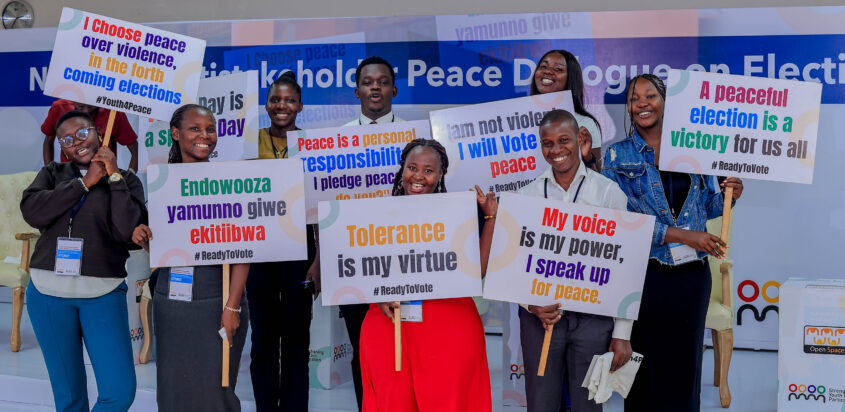
On 18th December 2025, the Open Space Centre convened a National Multi-stakeholder Peace Dialogue, at a time when political conversations were intensifying, and the road to the 2026 general elections was becoming increasingly heated. Elections have long been part of Uganda’s democratic journey, but experience has taught us that the period before, during and after can be fragile. Political tension raises, trust in institutions is tested, and young people who make up the majority of the population, often feel like spectators in decisions that directly affect their future. The dialogue provided a timely platform for reflection, open engagement and collective commitment towards peaceful, inclusive and youth-centred electoral processes.
In case you’re wondering why young people were at the heart of this dialogue, let’s rewind for a moment. Uganda is a young country and that reality shapes every conversation about election and peace. According to the Uganda Bureau of Statistics, individuals below the age of 35 make up approximately 78% of the population, and nearly 65% of registered voters fall within the youth demographic. Yet despite these numbers, many young people feel excluded from formal decision-making spaces and disconnected from institutions meant to safeguard electoral integrity. For some, elections have been associated less with opportunity and more with fear, tension or uncertainty rather than meaningful participation. It’s this gap that made centering youth in the National Peace Dialogue not just relevant but necessary.
The peace dialogue was designed as a strategic follow-up to a series of community election awareness outreaches. While these outreaches mobilized young people and communities to reflect on peaceful participation at local level, the national dialogue elevated these livid experiences into a shared space with institutions and decision-makers. It helped bridge the community realities with national-level conversations and responses.
A total of 112 participants attended the one-day convening. These included youth leaders, youth with disabilities, civil society organisations, political parties, the Electoral Commission, security agencies, religious and cultural institutions, media, academia and the private sector. Participants were drawn from Kampala, Mukono, Wakiso and other regions. They were selected based on their roles and influence in promoting peaceful elections. The diversity of voices ensured that discussions reflected the complexity of Uganda’s electoral environment and reinforced the principle that peace is a shared responsibility.
The programme was structured to encourage participation, dialogue and solution-building. It opened with a keynote address that grounded national-level discussions in community experiences of election-related tension and peacebuilding efforts. This set the tone for a day focused on learning, accountability and collaboration rather than blame.
Two high-level panel discussions anchored the dialogue. The first titled “From Margin to Centre: Women, Youth and Youth with Disabilities at the Frontline of Democratic Participation.” which highlighted persistent barriers to participation and the imprtance of inclusive and accessible electoral processes. Panelists emphasized that meaningful inclusion strengthens legitimacy, reduces tension and fosters collective ownership of peace.
The second panel “Building Trust: Multi-stakeholder Pathways to Peaceful Elections” which brought together institutional actors. This session focused on trust-building, ethical conduct and coordination during election periods. Discussions highlighted the importance of transparent communication, coordinated responses when tensions rise and sustained engagement with young people as essential pillars for peaceful elections.
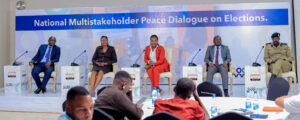
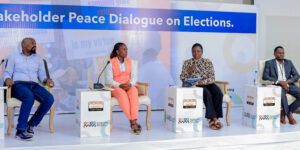 Panelists representing marginalized groups and institutional actors during the dialogue
The dialogue concluded with the development and signing of a Joint Peace Compact. Through this compact, participating stakeholder committed to promoting peaceful conduct, strengthening collaboration and sustaining youth-inclusive engagement throughout the electoral cycle. The signing marked a clear transition from dialogue to action and reinforced shared accountability for peace.
Several key policy recommendations emerged from the dialogue. Participants called for structured youth engagement in electoral decision-making, improved accountability, professional conduct among security actors during elections and intentional inclusion of women and youth with disabilities through accessible information and targeted outreach. These recommendations aimed to strengthen trust, reduce electoral risk and support peaceful democratic participation.
Overall, the National Multi-Stakeholder Peace Dialogue was characterized by openness, mutual respect and a strong sense of collective responsibility. It demonstrated the value of convening diverse actors to address shared challenges and identify practical pathways toward peace.
As Uganda continued its democratic journey following the 2026 general elections, the peace dialogue served as a reminder that peace is never automatic. It is built, protected and sustained through deliberate collective choice. The dialogue reinforced that peaceful elections did not begin or end at the ballot box; they were shaped by how communities engaged, how institutions acted and how differences are handled long after results are announced. Sustaining peace after elections requires continued civic awareness, respectful dialogue across political lines and accountability from all actors. The work of peace continues long after the election because peace is not an event, it’s a practice chosen every day.
Key voices from the dialogue reflected on responsibility, inclusion and what it truly takes to sustain peaceful elections.
“A peaceful, free and fair election is not the responsibility of one institution, it’s a shared responsibility across all actors.” Julius Mucunguzi, Spokesperson, Electoral Commission
“Many election-related disputes stem from limited voter education; especially as new voters enter the system.” Charity Ahimbisibwe, EC Electoral Laws Institute.
“Media has the power to claim the public or heighten tension. Neutral language and fact-checking are not optional-they are essential.” Damalie Mukhaye, Senior Journalist, Nation Media Group
“Peaceful elections depend on partnership between security agencies and communities, supported by timely and accurate information.” SSP Muhwezi Donald, Security Personnel.
“One of the biggest barriers to women’s participation is the normalization of violence during elections.” Georgia Tumwesigye, Forum for Women in Democracy
“People with disabilities are not one group with one need. Duty bearers must understand the disability clause and ensure participation is accessible to all.” Deo Imaligant, Youth with disabilities advocate.
“Young people must recognize that power is within them. Speaking up and participating consistently is how our voices begin to matter.” Yamu Burubuto, Youth leader
Author: Vivianne Kirabo Nakayiwa